
The Significance of Hill Running in Athletic Training
Introduction
Having grown up in the late 1970s and 1980s, and being an athlete throughout my life with a deep - seated love for football dating back to my earliest memories, one of the most inspiring training anecdotes from my childhood in the mainstream media was the hill that the legendary running back Walter Payton utilized for off - season conditioning. Online, stories abound about Payton's extraordinary conditioning regime, his practice of bringing athletes from various sports to train with him, and how most would ultimately succumb to exhaustion. As one of the NFL's most productive runners, perhaps among the greatest of all time, the hill was his well - kept secret.
I have been engaged in coaching for nearly two decades now, and I am thoroughly fascinated by hill running. I owe this passion to Payton. Given that speed is the overarching objective in all my training programs, hills (or stairs, for those without accessible hills nearby) are an indispensable component of any speed or conditioning regimen. My coaching career has been primarily split between Cal Poly and San Jose State, both of which boast significant hill or stadium inclines, ideal for rigorously training my athletes.
The Rationale Behind Hill Running
Strength and Power in the Context of Speed
When discussing speed, especially during the acceleration phase, strength and power are of utmost importance. Whether it's a forty - yard dash, a running back deftly navigating through a gap, a batter sprinting down the first - base line to beat a throw, or a forward bursting through a hole, the sudden burst of speed is the decisive factor. The initial three to five steps often determine the success of the effort.
Observe the NFL combine. When athletes run their 40 - yard dashes, the start is the most crucial determinant of a good time. Conversely, if a runner stumbles at the start or takes an erratic step, it's almost certain that the time will be underwhelming.
Hill running uniquely teaches the drive phase of a sprint. Due to the incline, runners must rely on the forefoot for climbing. A fundamental speed - training principle is that the front of the foot promotes speed, while the heels are for braking. Even larger athletes, who typically heel - strike first on flat ground, are compelled into an "optimal" sprinting position on the hill. Consider the lean adopted by world - class sprinters in the first 50 - 70 meters of a 100 - meter dash; the hill naturally facilitates achieving this position.
The Impact on Leg Strength
The most evident advantage of hill running is the load it places on the legs. I've long regarded parachute pulling, banded running, and partner towing as rather ineffective, as they all aim to replicate the benefits of hill training. Next to squatting, Olympic lifting, and kettlebell training, nothing rivals hill sprints in enhancing leg strength and explosiveness.
Using Hills for Lateral Applications
The majority of the teams I train for speed do not have frequent opportunities in their respective sports to run straight ahead, where traditional track workouts would be beneficial. Hence, we focus almost entirely on change - of - direction training. Many young athletes lack an understanding of how to turn, are unaware of their body's spatial position, rely on their toes to slow down, and often struggle to control their momentum while running.
Due to the hill's incline, when runners laterally climb, they instinctively position their drive foot in a "toe - in" stance. Failure to do so leads to a significant loss of efficiency, prompting an intuitive adjustment. On flat ground, a key aspect of footwork I teach is a subtle toe - in on the outside leg during a directional turn. This serves two purposes: it enables the runner to fully utilize the big toe during propulsion and aligns directionally with the intended path. Surprisingly, many young athletes lack this technique initially, resulting in slow and power - sapped attempts at redirection.
Moreover, gravity plays a significant role. The natural incline of the hill necessitates a forceful push, similar to what is required on flat ground during acceleration. If I can get an athlete to sprint vigorously up the hill, whether laterally or straight ahead, they gain context, which can then be translated to flat - ground performance.
The Benefits of Backward Hill Sprints
Backward hill running is an excellent method for intensively training athletes. The hill behind our sports complex at Cal Poly is approximately 35 yards in length with a 14 - percent grade, which is quite steep. We incorporate backward running into the final stage of our hill workouts. This is partly to push my athletes out of their comfort zones, partly to enhance the functional speed of defensive backs and linebackers, and partly to instill a sense of toughness.
During my college days, we had to backpedal around the outside of the Begley Building at EKU. This was deliberately designed to make us uncomfortable. The constant changes in incline outside made the experience miserable, as we were often required to do this for 15 minutes or more without a break. While it seemed harsh, it taught us an invaluable lesson: how to persevere through pain. It was a simple matter of intense leg burn, enough to make one nauseous.
The foot drive generated by backward hill running is unparalleled. It teaches athletes to push with maximum force from the forefoot. Recall that acceleration occurs at the front of the foot, and braking at the heel. This trains runners on the appropriate pressure application, placement, and efficient foot use.
Hills and Running Efficiency
Once again, due to the incline, runners are forced to give their all. Given the distance they need to cover uphill, casual hopping or half - hearted jumping only prolongs the ascent. As they strive to complete the climb as quickly as possible, a natural full - effort response is elicited.
Bounding has proven to be the most challenging aspect for my athletes. While other exercises may cause more pain, bounding requires them to exert maximum effort, coordinate movements for optimal efficiency, and completely deplete their anaerobic energy systems. It is truly rewarding to witness.
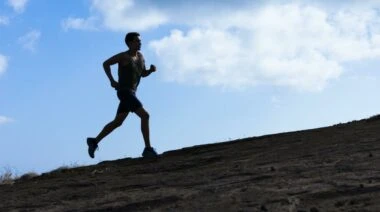
Featured Image: KieferPix/Shutterstock
The Benefits of Hill Running --- More Speed, Better Mechanics, and Power
•
Author: Kelton
•
Fitness
Life
Share this article